

How to Organize Your Home When You Have ADHD
/
If you've tried a dozen organizing systems, bought bins you never used the way you planned, or felt a wave of shame every time you looked at a cluttered counter — you're far from alone. Learning how to organize your home when you have ADHD often looks completely different from the advice in a typical decluttering article, and that's not a personal failing. It's a mismatch between generic organizing advice and how your brain actually processes tasks, time, and visual information.
This guide isn't about achieving a picture-perfect, minimalist home. It's about building practical, forgiving systems that hold up on your hardest days, not just your most motivated ones. We'll walk through why clutter can feel disproportionately overwhelming, what actually works room by room, and how to know when bringing in extra support — like a professional organizer — might make the whole process feel more manageable rather than something to face alone. A quick note before we start: this article is educational and is not medical advice. If you have questions about your own diagnosis, symptoms, or treatment, please speak with a qualified healthcare professional.
What Is ADHD and Why Can Home Organization Feel Challenging?
ADHD, or attention-deficit/hyperactivity disorder, affects how the brain manages attention, impulse control, and a set of mental skills known as executive function. People living with ADHD often experience differences in how they initiate tasks, sustain focus, and track time — all of which play a direct role in maintaining an organized home. This isn't about effort or intelligence; it's about a different underlying wiring for planning and follow-through.
Home organization, in particular, tends to ask for exactly the skills that can be hardest to access consistently: breaking a big task into steps, estimating how long something will take, remembering where things belong, and returning items to their place without being reminded. When a system doesn't account for these differences, it's common to see the same pattern repeat — an initial burst of motivation, a beautifully organized space, and then a slow drift back to clutter within weeks. That pattern isn't a personal failure. It usually just means the system wasn't designed with these differences in mind.
It's also worth noting that ADHD looks different from person to person, and even from day to day for the same individual. Some days, starting a small organizing task feels entirely manageable; other days, even opening a cluttered drawer feels like too much. A good system accounts for this variability rather than assuming consistent energy and focus every single day — which is exactly why the strategies in this guide lean toward flexible, forgiving structures rather than rigid routines that only work under ideal conditions.
Understanding Executive Function
Executive function is the set of mental skills responsible for planning, prioritizing, starting tasks, and regulating attention. Many individuals with ADHD find that these skills work differently, which can make traditional organizing advice — "just put things away," "make a schedule and stick to it" — far harder to execute consistently than it sounds.
A few specific executive function challenges show up often in the context of home organization:
Task initiation. Knowing a task needs doing isn't the same as being able to start it, especially for open-ended chores like "organize the closet."
Working memory. Holding multiple steps in mind at once — sort, decide, relocate, label — can be genuinely taxing.
Time blindness. Difficulty accurately sensing how much time has passed or how long a task will take can make a "quick tidy" spiral into hours, or feel too big to attempt at all.
Object permanence. If an item isn't visible, it can feel like it doesn't exist — which is why closed bins and drawers often become "out of sight, out of mind" black holes.
Understanding these patterns isn't about labeling yourself — it's about designing a home environment that works with your brain rather than constantly fighting against it.
It's helpful to think of executive function less like a single skill and more like a set of interconnected muscles, each of which can be stronger or weaker on any given day depending on stress, sleep, and overall demands on attention. A system designed around only one "good day" version of yourself will inevitably feel like it's failing on the harder days — which is why the most resilient ADHD-friendly systems are built for the lower end of that range, not the peak. If a system works even on a tired, distracted, low-energy day, it will work every day; the reverse is rarely true.
Expert Advice: If a system requires you to remember an extra step — closing a lid, checking a list, filing something away in the "right" place — expect that step to get skipped on busy days. The most durable ADHD-friendly systems minimize the number of steps between "I have this item" and "it's put away."
Why Clutter Feels Overwhelming
For many people, a messy room is simply an inconvenience. For someone with ADHD, visual clutter can function almost like background noise that's impossible to tune out — every object competes for attention at once, making it harder to focus on any single task, including the task of tidying up. This is sometimes described as visual clutter creating a kind of constant low-level cognitive load, since the brain has to actively filter out dozens of small distractions just to function in the space.
There's also a paradox worth naming here: clutter often builds precisely because putting things away requires the executive function skills that can be hardest to access, which means the very people most affected by visual clutter are often the ones for whom traditional decluttering advice is least accessible. Recognizing this cycle — rather than assuming it reflects laziness or a lack of care — is often the first real step toward a system that actually works.
This also explains why advice like "just declutter for twenty minutes a day" can fall flat without further adaptation. Twenty minutes of decision-making, in a space that already feels visually overwhelming, can be genuinely exhausting in a way that's hard to communicate to someone who doesn't experience clutter the same way. Breaking that same twenty minutes into a much smaller, single-category task — just the mugs, just the socks, just the mail from this week — tends to make the difference between a task that gets started and one that gets avoided entirely.
The Emotional Impact of Disorganization
Disorganization rarely stays purely practical — it tends to carry real emotional weight. Many individuals describe a persistent low-grade shame around clutter, particularly after repeated attempts to "just get organized" haven't stuck. That shame can, ironically, make the next attempt even harder to start, since the task becomes tangled up with feelings of failure rather than simply feeling like an inconvenient chore.
Family tension is another common thread — a partner or parent who doesn't share the same relationship with clutter may interpret disorganization as carelessness, which can create friction that has nothing to do with actual effort or intention. Naming this emotional layer honestly matters, because a system that only addresses the physical clutter without acknowledging the emotional history around it often won't stick for long. Organization strategies may help make daily routines easier and reduce some of this friction, but they work best when approached with self-compassion rather than a goal of "finally getting it right."
It's worth naming, too, that this emotional weight often compounds over years, not weeks. Someone who has spent a decade feeling behind on their own home often carries a much heavier emotional load into a new organizing attempt than someone starting from a neutral baseline. Recognizing that history — rather than expecting the emotional response to match only the current mess in front of you — can make it easier to approach the process with patience instead of frustration at yourself for not being "further along" already.
Benefits of an ADHD-Friendly Home
An organization system designed with ADHD in mind can make a meaningful difference in daily life. Many individuals find that a well-designed, ADHD-friendly space supports them in several ways:
Fewer lost items. Visible, labeled, consistent storage means less time spent searching for keys, chargers, or paperwork.
Lower decision fatigue. Simple, forgiving systems reduce the number of small decisions required just to put something away.
Reduced visual noise. Clear surfaces and defined zones can make a space feel calmer and easier to focus in.
More forgiving routines. Systems built around real habits — not idealized ones — are more likely to actually get used day to day.
Less friction with housemates or family. A shared, intuitive system reduces the chance of clutter becoming a recurring point of conflict.
It's worth repeating: organization strategies may help make daily routines feel more manageable, but they are not a treatment for ADHD itself, and they don't replace guidance from a healthcare professional for anyone with questions about their diagnosis or care.
Small Changes. Big Difference.
You don't need a perfect home — just a system that actually works for how you live. Book a consultation with Simplify with Sheeba to talk through what might help.
Start Small Instead of Organizing Everything
One of the most common — and most discouraging — mistakes is trying to organize an entire home in one exhausting weekend. For many people with ADHD, a project of that size triggers overwhelm before it even starts, and the all-or-nothing pattern that follows (an intense burst of effort, then total abandonment) is genuinely common and not a sign of failure.
A more sustainable approach is choosing a single, contained space — one drawer, one shelf, one small zone — and finishing it completely before moving to the next. This does two things: it creates a real, visible win rather than an abstract goal, and it keeps the task small enough that starting doesn't feel impossible. Momentum matters more than scope here; five small, completed wins tend to produce better long-term results than one ambitious project abandoned halfway through.
A useful gut-check before starting any organizing task is to ask whether it could realistically be finished in the time and energy available right now — not the amount you wish you had, but what's actually available today. If the honest answer is no, the task is too big for this attempt and should be broken down further, rather than started anyway in hopes that momentum will carry it through. Sizing a task correctly before beginning is often what separates a project that gets finished from one that gets abandoned halfway through, looking messier than before it started.
Declutter Before You Organize
It's tempting to jump straight to bins, labels, and pretty containers, but decluttering has to come first — no organizing system can compensate for simply having too much in too little space. For ADHD-friendly decluttering specifically, a few adjustments to the typical process tend to help:
Use very simple categories. Keep, donate, and "unsure" is usually enough — too many categories can itself become a source of decision fatigue.
Set a visible timer. A concrete time limit helps counter time blindness and makes the task feel finite rather than open-ended.
Handle the "unsure" pile separately. Items you can't decide on quickly rarely benefit from more deliberation in the moment — box them, date the box, and revisit in a few months.
Don't declutter while tired. Decision-making is harder when executive function resources are already depleted; even twenty minutes earlier in the day often works better than an hour at night.
It also helps to accept, going in, that some decisions simply won't get made in the first pass, and that's fine. The goal of an initial decluttering session isn't to resolve every single item — it's to meaningfully reduce volume and momentum toward a workable system. Items that stay in the "unsure" pile after a second or third look often become much easier to decide on once the surrounding clutter has already cleared, since fewer competing decisions are demanding attention at the same time.
Room-by-Room ADHD Organization Guide
Every room asks something slightly different of your attention and habits. Here's how to adapt each space with ADHD-friendly principles in mind.
Living Room
The living room tends to collect a little of everything — mail, chargers, blankets, remote controls. A single, visible "catch-all" basket near the main seating area gives wandering items an obvious, low-effort home, which is far more sustainable than expecting everything to go directly to its "proper" place every time. A quick end-of-day sweep to empty that basket back into its actual homes keeps the system from becoming just another pile in disguise.
Kitchen
Keep everyday items — the mug you actually use, the pan you cook with most — at eye level and easy to reach, while less-used items move to harder-to-access spots. Clear, labeled containers work better than opaque ones, since visibility reduces the "out of sight, out of mind" effect that closed storage can create. A small counter zone for dishes waiting to be put away, rather than expecting every dish to be dealt with the moment it's washed, can also relieve a surprising amount of daily pressure.
Pantry
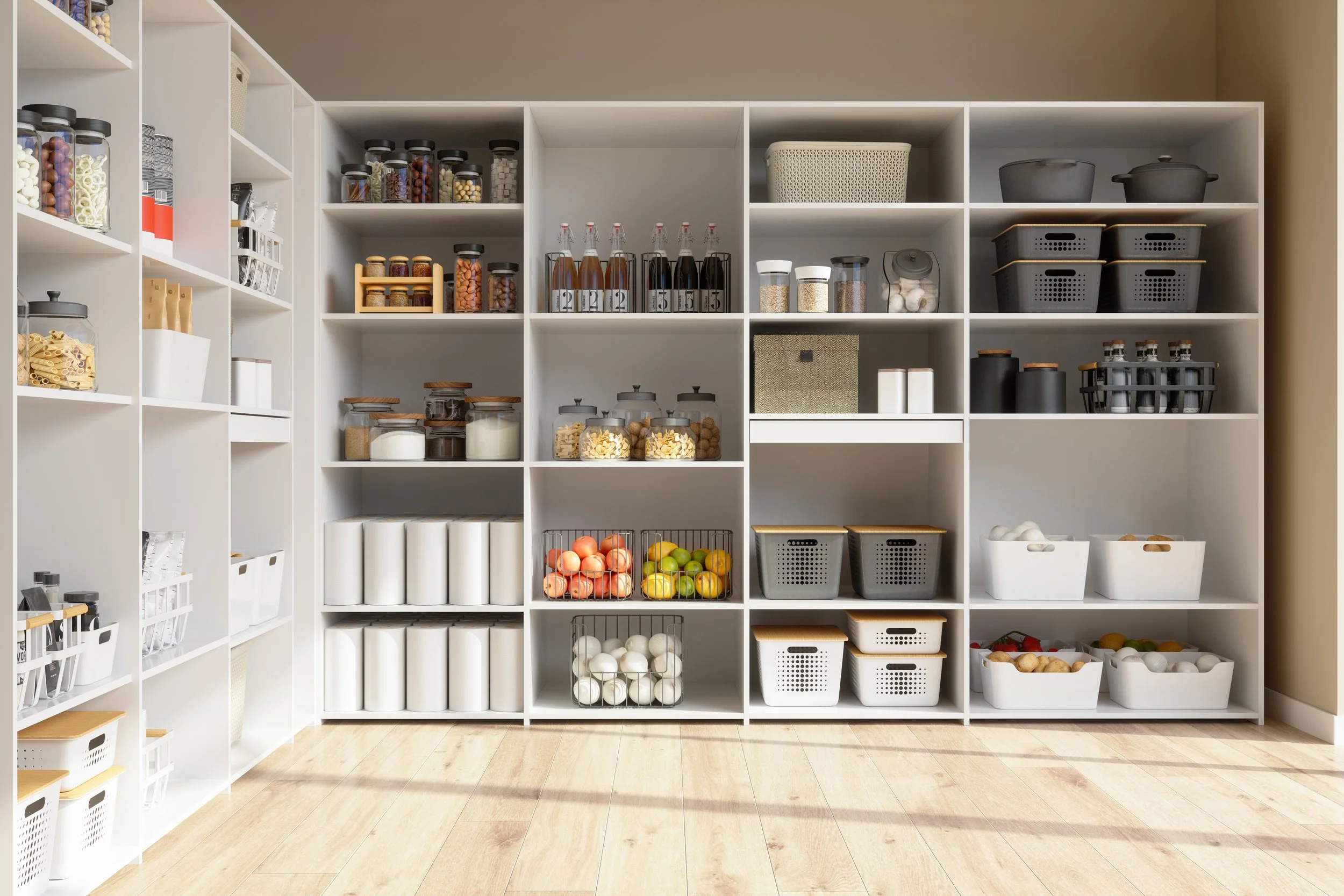
Grouping by how you cook, not strict category, tends to work better than a rigid system — snacks together, baking items together, and so on. Clear bins let you see what's running low at a glance, reducing both duplicate purchases and the frustration of a pantry that looks full but never has what you actually need.
Bedroom
An open hamper is almost always more effective than a lidded one — the extra step of lifting a lid is often enough to derail the habit entirely. Keeping a clear surface near the bed for the items you use daily (phone charger, glasses, water) reduces the temptation to let that same surface become a catch-all for everything else.
Closet
Visibility is everything here. Open shelving, clear bins, and hanging rather than folding — wherever possible — reduce the number of steps between "clean laundry" and "put away," which is often where ADHD-friendly systems succeed where traditional folded-drawer systems fail. A dedicated hook or hanger for tomorrow's outfit, set out the night before, can also remove one entire decision from an already rushed morning.
Bathroom
Small, high-traffic spaces benefit from grouping by routine rather than product type — everything for a morning routine in one spot, everything for a nightly routine in another. This mirrors how the space is actually used, rather than an abstract organizational logic.
Laundry Room
A simple two-basket system — one for lights, one for darks — removes an entire decision point from laundry day. Keeping detergent and supplies visible and within easy reach reduces the friction of starting a load in the first place.
Garage
Garages tend to become the default home for anything without an obvious place elsewhere. Broad, clearly labeled zones — tools, seasonal items, sports equipment — are more sustainable here than a highly detailed system, since a simpler structure is easier to maintain consistently over time. Leaving a little visible open floor space, rather than filling every inch, also gives new items somewhere to land temporarily before they're properly sorted, instead of getting wedged wherever there's a gap.
Home Office
A single, visible inbox tray for incoming paperwork prevents documents from spreading across every surface. Keeping only current, active items on the desk — with anything archival moved elsewhere — supports focus far better than a desk that tries to hold everything at once.
Tip: If a system requires remembering to close something, sort something, or check something before an item is "away," it will eventually get skipped on a hard day. Open, visible, one-step storage tends to outperform anything more elaborate.
Storage Solutions That Work Well for ADHD
Not all storage products are created equal when it comes to ADHD-friendly systems. A few principles tend to matter more than brand or aesthetics:
Open over closed. Clear bins, open shelving, and baskets without lids reduce the "out of sight, out of mind" effect.
Fewer steps to access. A single open basket beats a labeled bin inside a drawer inside a cabinet — every extra step is a place the habit can break down.
Generous, forgiving sizing. Slightly oversized bins tolerate imperfect placement better than tightly fitted ones, which can start to feel punishing when things don't fit "just right."
Visual, not just text, labels. Pictures or color-coding can be faster to process at a glance than reading a label, especially when tired or distracted.
Designated landing zones. A single obvious spot for keys, wallet, and bag near the door removes a recurring daily search entirely.
It's also worth resisting the urge to buy every product a system seems to call for before testing it in real life. A single trial bin or basket, used for a week or two in its intended spot, reveals far more about whether a solution will actually work than a fully purchased and installed system that turns out to be the wrong shape, size, or level of visibility for how the space is really used. Small, low-cost tests before a full investment save both money and the discouragement of installing something elaborate that doesn't fit daily habits.
Daily Habits That Make Organization Easier
Systems only work if the daily habits around them are realistic. A few small, low-effort habits tend to have an outsized impact:
The one-touch rule. Where possible, handle an item once — open mail directly into the recycling or the inbox tray, rather than setting it down "for later."
A nightly two-minute reset. Not a full tidy, just returning the most visible surfaces to a baseline before bed.
Visual cues over memory. A sticky note on the door, a phone reminder tied to a specific action, or a visible checklist all reduce reliance on remembering unaided.
Pairing new habits with existing ones. Attaching a new habit to something you already do consistently — like sorting mail while the kettle boils — tends to stick better than a habit with no existing anchor.
None of these habits need to happen perfectly every single day to be worth building. A habit followed five days out of seven still produces a meaningfully calmer home than no habit at all, and expecting flawless daily consistency often sets the bar high enough that a single missed day feels like a reason to abandon the whole effort. Aiming for "mostly consistent" rather than "perfectly consistent" tends to produce far better results over the course of months.
Simple Weekly Maintenance Routine
A heavy, all-at-once cleaning day is often harder to sustain than short, frequent check-ins. Consider a simple weekly rhythm:
☐ One ten-minute "reset" session per high-traffic room (kitchen, entryway, bedroom)
☐ A quick check of the "unsure" decluttering box, if one is still active
☐ Returning any wandering items to their designated landing zones
☐ A brief look at the inbox tray or paper system to prevent buildup
☐ One small, optional win — a single drawer or shelf — if energy allows, with no obligation if it doesn't
The goal isn't perfection every week — it's preventing small pockets of clutter from compounding into a project that feels too big to start again.
How to Build Sustainable Organization Systems
The most sustainable systems share a few common traits, regardless of the specific room or product involved. They tend to be simple enough to maintain on a low-energy day, forgiving of imperfect use, and built around actual behavior rather than an idealized version of it. A system that only works when followed exactly as designed is a system that will eventually break down — the goal is resilience, not perfection.
It also helps to treat a system as a draft rather than a finished product. What works in the first month may need adjusting once a new routine, a new job, or a new season changes daily patterns. Revisiting and tweaking a system periodically isn't a sign that it failed — it's a normal part of keeping any system aligned with real life.
Another trait worth building in deliberately is redundancy for the moments willpower runs low. A single point of failure — one drawer that has to stay perfectly sorted, one habit that has to happen every single day without exception — tends to collapse the whole system the first time life gets busy. A more resilient design assumes some days will be missed, and makes sure a missed day doesn't cascade into total collapse. A slightly messy basket that's easy to reset beats a perfectly labeled system that falls apart the moment one label gets skipped.
Organization Mistakes to Avoid
A few patterns show up especially often for people with ADHD attempting to organize solo, and recognizing them ahead of time can save considerable frustration:
Aiming for a "perfect," Pinterest-style system. Highly detailed, aesthetically precise systems are often the least durable, since they require more maintenance steps than a simpler alternative.
Tackling the whole home at once. This tends to trigger overwhelm before the project even gets underway.
Choosing closed storage for daily-use items. Lids and drawers add friction exactly where it matters least to add it.
Skipping the decluttering step. Organizing around excess volume just creates a tidier-looking version of the same problem.
Expecting a system to work forever without adjustment. Life changes, and systems that can't flex with it tend to quietly fail.
Copying someone else's system exactly. A method that works beautifully for a friend or an influencer may not map onto your own routines at all, and forcing the fit rarely lasts.
Technology and Apps That Can Help
A range of tools can support an ADHD-friendly organization system, though the right one varies by person. Visual task and reminder apps can externalize memory rather than relying on it internally. Shared digital calendars help offload time-blindness-related planning, particularly for household tasks shared between family members. Simple habit-tracking apps can provide a visual record of consistency, which some people find motivating in a way that abstract goals aren't. As with storage systems, the best technology is the one that's simple enough to actually keep using — a highly detailed app abandoned after a week helps less than a basic one used consistently.
It's worth being selective here rather than downloading every recommended tool at once. Adding too many new digital systems at the same time as a home reorganization can itself become overwhelming, undermining the very goal of reducing cognitive load. A more sustainable approach is introducing one tool at a time, giving it a few weeks of genuine use, and only adding another once the first has become an established habit rather than one more thing competing for attention.
How Family Members Can Offer Support
Family members and housemates play a real role in whether an organization system succeeds long-term. A few approaches tend to help far more than frustration or repeated reminders:
Use the same system, not a separate one. If one household member maintains a completely different method, shared spaces tend to drift back toward clutter.
Offer specific help, not general criticism. "Want help sorting the mail pile together?" tends to land better than "this is such a mess."
Recognize small wins. Acknowledging progress, even partial, reinforces the habit far more effectively than only noting what's still undone.
Avoid taking over entirely. A system imposed without input from the person who'll maintain it day to day is unlikely to stick, however well-intentioned.
It's also worth acknowledging that supporting a family member with ADHD around organization can be genuinely frustrating at times, and that frustration is understandable rather than something to feel guilty about. The goal isn't for a supporting partner or parent to suppress every reaction, but to recognize when frustration is about to turn into criticism that undermines the very system everyone's trying to build together. A brief pause before responding to a cluttered surface often does more good than an immediate reaction, however justified that reaction might feel in the moment.
Create Space for Calm.
A home that works with your brain, not against it, is possible. Let's design a system built around how you actually live.
Living With Clutter vs. Living With Personalized Organization Systems
It can help to see the practical difference side by side — not to judge where you are now, but to clarify what a personalized system is actually working toward:
FactorLiving With ClutterLiving With a Personalized SystemFinding everyday itemsFrequent searching, often under time pressurePredictable, visible homes for daily-use itemsMorningsRushed, often stressfulSmoother, with fewer last-minute searchesEmotional experienceGuilt, avoidance, and shame around certain spacesLess shame, more forgiving relationship with the spaceMaintenance effortHigh — every reset feels like starting from scratchLower — small, forgiving habits keep the system goingHousehold relationshipsClutter can become a recurring source of tensionShared, intuitive systems reduce friction between household members
The goal was never a flawless home — it's a lower-friction one, where the system does more of the work than willpower alone.
Sarah's Story: An Illustrative Example
The following is an original, illustrative example created for this article — not a real client testimonial.
Sarah, a busy Toronto professional, had spent years feeling like she was constantly behind on her own home. Between a demanding job and parenting two young kids, the house had become a source of quiet, ongoing stress — closets that no longer closed, a kitchen counter that collected everything except actual cooking, and a persistent sense that she "should" be able to keep up but somehow never could.
She'd tried plenty of systems before. Elaborate labeled bins from a big-box store, a color-coded closet organized over a single exhausting Sunday, a chore chart that lasted exactly nine days on the fridge. Each attempt started with genuine motivation and ended the same way — a slow drift back to the same clutter, and a familiar wave of frustration and self-blame that made the next attempt even harder to start.
What made Sarah's situation particularly exhausting was the gap between how competent she felt at work and how defeated she felt at home. She managed complex projects and tight deadlines professionally without much trouble, which made the repeated failure to "just organize a closet" feel confusing and, at times, embarrassing. It wasn't until she started separating the idea of capability from the specific mismatch between generic organizing advice and her own executive function patterns that the frustration started to ease, even before a single bin was touched.
When Sarah reached out for professional organizing support, the process looked different from what she'd tried before. Instead of a single overwhelming weekend, the project was broken into small, contained sessions — one drawer, one shelf, one zone at a time — each one finished completely before moving to the next. The organizer asked about her actual morning routine before touching a single closet, and the resulting system was built around how she really got dressed, not an idealized version of a "perfectly organized" wardrobe.
The kitchen shifted from closed cabinets to open, labeled bins for the items she reached for daily, with everything else moved out of the way entirely. The entryway got a single, generously sized landing basket for keys, bags, and school items — nothing fancy, just one obvious spot that removed an entire daily search. Nothing about the new systems required Sarah to remember an extra step; every design choice was aimed at reducing friction rather than adding a "better" habit she'd have to enforce through willpower.
Months later, the visible transformation mattered less than the quieter shift underneath it. Mornings weren't perfect, but they were calmer. The shame that used to creep in every time she looked at a cluttered surface had noticeably softened, replaced by a system she trusted to hold up even on her hardest days. Perhaps most tellingly, when a busy week did throw the entryway basket into disarray, it took her two minutes to reset it rather than triggering the old spiral of guilt and avoidance — proof, in a small way, that the system was doing its job even when life didn't cooperate perfectly. That's the real measure of success in ADHD-friendly organization — not a flawless home, but one that finally works with her, instead of constantly demanding more from her than she had to give.
When It May Help to Hire a Professional Organizer
DIY strategies genuinely help many people, but there are moments when bringing in a professional organizer for ADHD can make a meaningful difference:
You've tried multiple systems on your own, and none have lasted more than a few weeks.
The scale of the project feels too overwhelming to know where to even begin.
Decluttering decisions repeatedly stall, especially around sentimental or emotionally loaded items.
You're navigating a major life transition — a move, a new baby, a job change — on top of existing organization challenges.
You want an objective, judgment-free second perspective on what will actually work for your specific routines.
None of this means solo efforts have failed you — it simply means some projects benefit from an outside perspective and an extra set of hands, the same way many tasks do regardless of how anyone's brain works.
It's also worth considering the cumulative cost of repeated solo attempts, not just in time but in the emotional toll of another cycle of motivation and disappointment. For some people, that pattern itself becomes a reason to seek support sooner rather than later — not because they couldn't eventually figure it out alone, but because each unsuccessful attempt makes the next one harder to start. Bringing in a professional at that point isn't a last resort; it's simply choosing a more direct path to a result that solo effort was always going to take longer, and cost more emotionally, to reach.
How Simplify with Sheeba Helps Create Personalized Organization Systems
Every project at Simplify with Sheeba starts with understanding your actual routines, not a generic template. For clients navigating ADHD specifically, that often means prioritizing open, visible storage over anything that adds an extra step, breaking projects into small, completed phases instead of one overwhelming weekend, and building in enough flexibility that the system can flex as life changes.
The goal is never a picture-perfect home that only works under ideal conditions. It's a home that holds up on ordinary days, tired days, and busy days — because that's when a system actually needs to work. Whether the project is a single closet or a full-home reset, the process stays the same: listen first, keep it simple, and build something that supports you rather than something you have to constantly maintain through effort alone.
This approach also extends to how the whole experience is structured, not just the storage systems themselves. Sessions are paced to match energy levels rather than an arbitrary schedule, decisions are never rushed past the point of comfort, and there's no expectation that a client arrive with the space already partly sorted or "presentable" before a session begins. The work starts exactly where things are, without judgment about how they got that way.
Organization Made Simple.
A judgment-free process, built around how you actually live. Let's talk about what might help your home function better.
Areas We Serve
Simplify with Sheeba provides personalized home organization services across Toronto and the entire Greater Toronto Area, including:
Toronto, Downtown Toronto, North York, Scarborough, Etobicoke, York, East York, The Beaches, Leslieville, Riverdale, Leaside, High Park, Forest Hill, Markham, Richmond Hill, Ajax, Whitby, Pickering, Oshawa, Mississauga, Brampton, Vaughan, Oakville, Milton, and the entire Greater Toronto Area.
Frequently Asked Questions
How do I organize my home when I have ADHD?
Start with a single small space rather than the whole home, declutter before organizing, and favor open, visible storage over closed bins or drawers that add extra steps between using an item and putting it away.
Can a professional organizer help people with ADHD?
Yes. A professional organizer can offer objective, judgment-free support, break large projects into manageable phases, and design systems specifically around your routines rather than a generic template.
What are ADHD-friendly storage solutions?
Open shelving, clear bins without lids, generously sized containers, and visual labeling all tend to reduce the friction that causes closed or overly detailed systems to fall apart over time.
Should I declutter before organizing?
Yes. Decluttering first ensures a storage system isn't trying to compensate for excess volume, which is one of the most common reasons organizing projects don't last.
How long does organizing usually take?
It varies widely by scope and volume, but breaking a project into small, completed sessions — a drawer or shelf at a time — tends to work better than trying to estimate and complete an entire home at once.
What room should I organize first?
A small, high-visibility, high-frustration space — like an entryway or a single closet — tends to build the most momentum, since the win is quick and immediately noticeable in daily life.
How do I stay organized long term?
Short, frequent maintenance habits — like a nightly two-minute reset — tend to be more sustainable than infrequent, large cleaning sessions, since they prevent clutter from compounding into an overwhelming project.
Can organization reduce everyday stress?
Many individuals find that a well-organized, ADHD-friendly space makes daily routines feel calmer and more predictable, though organization is not a treatment for ADHD itself.
How often should I declutter?
A light seasonal check-in, alongside small weekly maintenance habits, is generally enough to prevent clutter from building back up between larger projects.
How do I keep clutter from coming back?
Favor systems with the fewest possible steps between using an item and putting it away, and revisit the system periodically as routines change, rather than expecting one setup to work forever unchanged.
Is this article medical advice?
No. This article offers general organizational strategies and is not medical advice. Anyone with questions about an ADHD diagnosis, symptoms, or treatment should speak with a qualified healthcare professional.
Do organization systems need to look a certain way to work?
No. The most effective ADHD-friendly systems prioritize function and low-friction daily use over a particular aesthetic — a simple, slightly imperfect system that's actually used beats an elaborate one that isn't.
Conclusion
Learning how to organize your home when you have ADHD isn't about willpower, discipline, or finally finding the "right" system after enough tries. It's about designing a home environment that works with how your brain actually processes tasks, time, and visual information — one small, forgiving system at a time. Progress here looks like fewer daily frustrations and a little more calm, not a flawless, magazine-ready home.
If you've read this far, you already know which space in your home is asking for a different approach. Simplify with Sheeba is here to help you build a system that actually fits your life, with patience, expertise, and zero judgment along the way.
Your Organized Home Starts Here.
Book a consultation with Simplify with Sheeba and let's build an organization system designed around how you actually live.